The Legacy Mesh
Cross-Chain Transfers Connecting USDT and USDT0
As USDT0 expands to new chains, users need a way to move liquidity between emergent ecosystems and networks where USDT has already been deployed. To solve this, USDT0 has introduced the Legacy Mesh: a cross-chain liquidity infrastructure that connects legacy USDT deployments with the USDT0 omnichain ecosystem through a shared, non-custodial hub.
What Is the Legacy Mesh?
The Legacy Mesh connects native USDT deployments with the USDT0 Network's single, interoperable liquidity network. It is designed for chains where USDT is already live to connect to the broader USDT0-enabled ecosystem without replacing contracts, migrating users, or relying on wrapped assets.
Currently, the Legacy Mesh connects:
- Ethereum (native USDT via ERC-20)
- Tron (native USDT via TRC-20)
- TON (native USDT via TON token format)
- Arbitrum (canonical USDT0 hub)
- Solana (native USDT via SPL-20)
- CELO (native USDT via ERC-20)
- Any chain with native USDT0 integration
These chains retain their existing USDT implementations while gaining seamless connectivity to each other and all USDT0-enabled chains. Within this system, all USDT0 products are backed by real, redeemable assets on both sides of every transfer. This extends the utility and reach of USDT while eliminating the need for fragmented pools, wrapped tokens, and synthetic stablecoin representations.
As more chains are added to the mesh over time, each integration will further strengthen the network and unify the stablecoin experience.
Why The Legacy Mesh Matters
The Legacy Mesh solves a fundamental coordination problem: how do you unify fragmented liquidity across legacy systems without forcing a disruptive migration? The answer is to create a seamless path between classic stablecoin deployments and today's omnichain reality, without requiring the market to choose one over the other.
Benefits to this approach include:
- Unified Liquidity Across Legacy and New Chains: Native USDT deployments represent billions in circulating supply and real-world usage. The Legacy Mesh makes that liquidity accessible to newer ecosystems built around USDT0 without the need for immediate full-stack upgrades.
- Future-Proof Interoperability: Not all chains are ready to support USDT0 natively. The Legacy Mesh lets them interoperate with USDT0's unnified liquity layer today, while preserving the option to upgrade to full OFT-based deployment when they are ready, with minimal disruption.
- Fully-Backed Liquidity: Every transfer through the mesh is backed by real assets, either via liquidity pools or direct mint/burn mechanisms. This minimizes depeg risk and ensures maximum capital efficiency.
How The Legacy Mesh Works
The Legacy Mesh uses a hub-and-spoke architecture to connect legacy USDT deployments to the broader USDT0 network. Each supported legacy chain connects to a canonical USDT0 hub, which acts as the routing layer for cross-chain transfers.
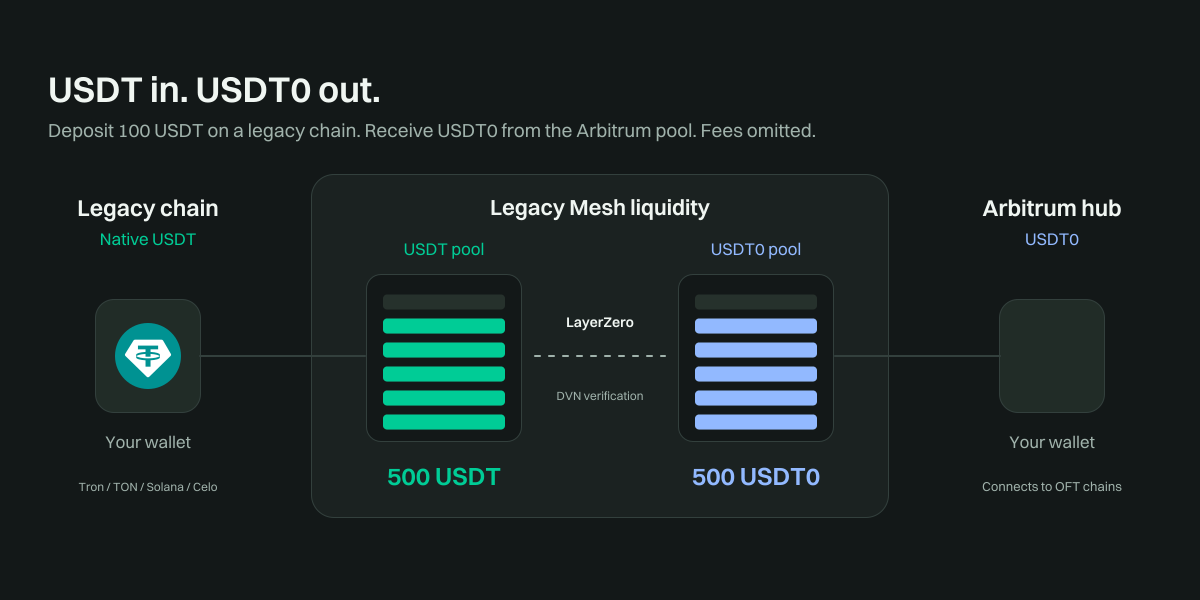
These capabilities can be accessed through the USDT0 Transfer Hub, which provides a seamless way to move USDT into the mesh and receive native USDT0 on any destination chain. Simply select your source and destination chains, and the Legacy Mesh handles the routing automatically.
Multihop Routing
Transfers through the Legacy Mesh may use a two-hop routing mechanism with Arbitrum as the central hub:
-
Hop 1: Legacy Chain → Arbitrum Hub Your USDT is transferred from the source chain (e.g., Tron, TON, Solana) to Arbitrum, where it is converted to USDT0 via the liquidity pool.
-
Hop 2: Arbitrum Hub → Destination Chain The USDT0 is then sent from Arbitrum to any connected USDT0 network using the OFT standard's native mint/burn mechanism.
This hub-and-spoke design allows users to transfer from any legacy USDT chain to any USDT0 chain in a single user action, while the underlying infrastructure routes through Arbitrum.
Differently from USDT0, the Legacy Mesh has a 0.03% fee attached to each transfer, paid in USDT.